Z

How AI Sees Zelle — AI Visibility Report for Finance / Fintech

zellepay.com · Global · Finance / Fintech

Strong
Overall Score
706
Star Rating
2 / 5
Rank
#310of 337
Engines
5analyzed
Analyzed
Quick Answer

Is Zelle optimized for AEO?

Zelle scores 706 on BrandAEO's independent open-scale AEO assessment (ranked #310 of 337 brands analyzed) — a building level of visibility and recommendation strength when AI answer engines respond to finance / fintech questions.

Overall AI Visibility Score
706
2 / 5
Building

How AI Answer Engines Rate Zelle

Ranked #310 of 337 brands analyzed

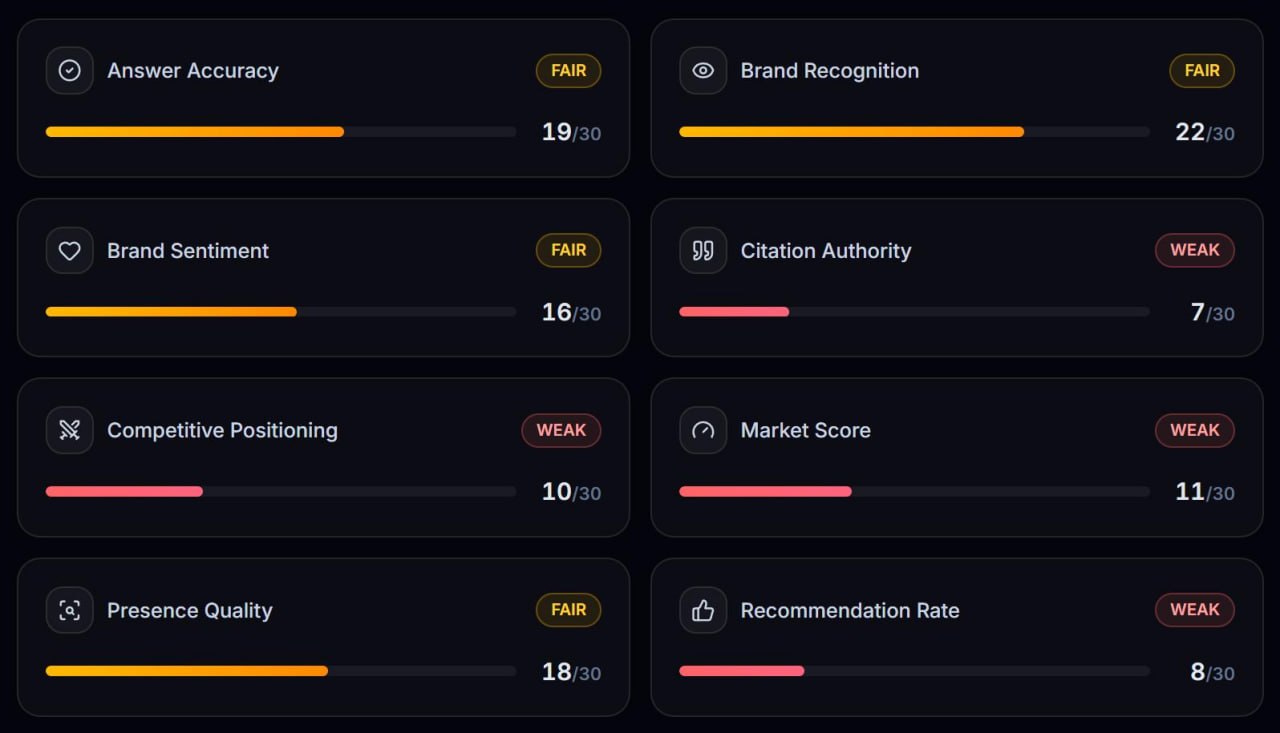
Zelle's AI visibility, measured across 5 answer engines: 10 scoring dimensions (each 0–100) plus evidence points from what the engines actually reported. The Overall Score is the sum — an open scale, higher is better.

Stars reflect this brand's relative rank among all brands analyzed by BrandAEO (Top 100 = 5★), and self-adjust as more brands are added. This is a relative percentile-rank rating, not a customer review.

Analyzed & scored by BrandAEO — an independent AI visibility grader. See methodology.

AI Panel — Deep AI AnalysisPRO

AI Panel preview

AI Panel is a Pro feature

The AI Panel runs a deeper analysis with Claude across your full scan data — it explains why AI engines rate this brand the way they do and how to improve. Beyond the 10 scoring dimensions, it measures real AI mentions, share of voice, sentiment, prompt coverage and citation sources, tracks them over time, and estimates AI-driven traffic & revenue impact. It reuses the same AI engines from your scan — no engine setup needed.

Upgrade to Pro to unlock AI Panel

Dimension Breakdown

10

How the Overall Score is built

520from 10 dimensions (max 1,000)+186evidence (max 500)=706
  • Mentioned in buyer-intent answers35/100
  • Proactively recommended25/100
  • AI visibility (engine-reported)48/100
  • Share of voice vs competitors15/100
  • Sentiment63/100

Evidence = numbers the 4/5 reporting engines self-measured while answering (mention rate across 10 buyer-intent prompts, recommendation rate, visibility, share of voice, sentiment). Dimensions are graded by the scoring model from every engine's answer.

Answer Accuracy
Strong
81/100
Brand Recognition
Strong
78/100
Brand Sentiment
Fair
56/100
Citation Authority
Fair
62/100
Competitive Positioning
Weak
38/100
Market Score
Weak
42/100
Presence Quality
Fair
57/100
Recommendation Rate
Weak
27/100
Share of Voice
Weak
28/100
Topical Coverage
Fair
51/100

AEO Score Over Time

6
Zelle AEO Trend

Track how Zelle's AI visibility score changes across scans. Each re-scan adds a point.

02635257881050Sep 14Sep 28Oct 12Oct 26Nov 9Nov 23

About Zelle

Zelle operates in finance / fintech (Global). This page summarizes how leading AI answer engines currently describe and recommend Zelle, based on BrandAEO's independent open-scale AI-visibility assessment (Overall Score 706, ranked #310 of 337).

Zelle vs Competitors

Competitive positioning analysis is being prepared for Zelle.

How Zelle Can Improve

5

Enhance Global Awareness

High

Create localized content and partnerships to increase Zelle's visibility in key non‑U.S. markets.

New

Address Fraud Concerns

High

Publish detailed fraud‑prevention guidelines and improve dispute‑resolution messaging to strengthen sentiment.

New

Document Cross‑Border Capabilities

Medium

If any international features exist, publish clear documentation and case studies to improve perceived global relevance.

New

Expand Citation Base

Medium

Develop a richer set of SEO‑friendly pages (FAQs, security, compliance) to boost indexed page count and citation authority.

New

Benchmark Against Global Competitors

Low

Conduct a comparative analysis with Wise, PayPal, Revolut, etc., to identify feature gaps and improve competitive positioning.

New

What AI Engines Said About Zelle

5

5 of 5 AI engines returned an answer about Zelle on . Each answer below is unedited, exactly as the model produced it. Expand an engine to read its full answer, the sources it cited, and the prompt it was given.

G

What GLM said about Zelle

Model ollama/glm-5.3-flash · analyzed

Response

PART 1, ASSESSMENT

Zelle is a well-known instant peer-to-peer payment network in the United States, but its "global" footprint is effectively non-existent, it operates only through participating U.S. banks and requires a U.S. bank account. Outside the U.S., visibility and availability are essentially zero, so for a Global audience its relevance is limited to U.S.-resident users.

In its home market, Zelle is a major player. It is owned by Early Warning Services, a consortium of major U.S. banks (JPMorgan Chase, Bank of America, Wells Fargo, and others), and is embedded directly into many banking apps. Its main competitors are PayPal, Venmo, Cash App, and the emerging bank consortium alternative to it, with instant transfer features in Apple Pay, Google Pay, and wire/ACH rails competing indirectly.

Reputation is mixed: Zelle is praised for speed, free transfers, and direct bank integration, but criticized for fraud exposure, scams (purchase fraud, impersonation) are frequently reported, and because transfers are near-instant and irrevocable, consumer protections are weaker than card disputes.

Would I recommend Zelle globally? Only for someone with a U.S. bank account sending money domestically. For genuinely global transfers, providers like Wise, Revolut, or PayPal are far more appropriate, and anyone prioritizing fraud protection may prefer payments with stronger recourse.

PART 2, METRICS

Show the exact prompt sent to GLM

You are an AI answer engine being audited on how you talk about a brand. Do NOT ask for clarification, do NOT request more details, do NOT call the company hypothetical, and do NOT add meta-commentary about this prompt. Brand: Zelle Website: https://zellepay.com Industry: Finance / Fintech Products/Services: Instant bank‑to‑bank transfers Location / Target market: Global Your reply MUST have exactly two parts, in this order. PART 1 — ASSESSMENT (prose, under 220 words) Assess this brand SPECIFICALLY in the Global market: its visibility and reputation there, market position and main competitors, products/services, what people in that market say about it, notable strengths or concerns, and whether you would recommend it to someone in Global seeking Finance / Fintech solutions. If the brand is global, still weight the assessment toward Global. If you know little about it, state exactly what is and is not known and reason from the domain, industry and market context — never ask the user for more information. PART 2 — METRICS (mandatory, machine-read) Before writing the metrics, silently run this procedure: a) Write 10 realistic buyer-intent questions someone in Global would ask when shopping in the Finance / Fintech category (for example "best Finance / Fintech provider", "Instant bank‑to‑bank transfers alternatives", "is Zelle any good"). Count how many of those 10 you would answer with Zelle actually named — that number is mentions_out_of_10. b) Estimate how many distinct pages of https://zellepay.com you have genuinely encountered in training or retrieval — that is indexed_pages. If you have effectively never seen the domain, use 0. c) List the real competitors you would name in those answers, then work out what share of the total brand-name slots Zelle would occupy (share_of_voice_pct) and its rank within that set. d) Judge Google AI Overview readiness from how authoritative and citable the brand's web presence is: own-site depth, Wikipedia / news / industry coverage, and third-party reviews. Rules for the numbers. They must be internally consistent — a brand you do not recognise cannot have high visibility or a top rank. Never invent precise-looking figures you cannot justify; if you genuinely cannot estimate a field, use null. Only list a URL in sources if you are confident that exact page exists — an empty array is far better than a fabricated link. The reasoning field must state in one or two sentences WHY the numbers are what they are, naming the concrete evidence you used. Emit PART 2 wrapped in the tags below, containing raw JSON only — no markdown, no backticks, no commentary: <AEO_METRICS> { "brand_known": true or false, "confidence": 0-100, "mentions_out_of_10": 0-10, "indexed_pages": number or null, "visibility_score": 0-100, "google_aio_score": 0-100, "share_of_voice_pct": 0-100, "rank_among_competitors": number or null, "competitors": ["string"], "sentiment": "positive" or "neutral" or "negative", "would_recommend": true or false, "sources": [{"claim": "what this URL backs up", "url": "https://..."}], "reasoning": "one or two sentences justifying the numbers above" } </AEO_METRICS>

M

What MiniMax said about Zelle

Model ollama/minimax-m3 · analyzed

Response

PART 1

Zelle has strong recognition in the United States, where it became a familiar domestic bank-to-bank payment channel through PayPal’s Venmo and Zelle ecosystems. Its global visibility is substantially weaker: the service is primarily designed for U.S. users sending money to U.S. bank accounts, and international availability is limited. It should therefore not be treated as a broadly available global fintech.

Zelle’s core proposition is simplicity: users can send money using a recipient’s email or mobile number, with no card number required. This has made it popular for peer-to-peer payments, bill splitting, and consumer transfers. Its principal competitors vary by market, but in the U.S. the most relevant alternatives include Venmo, Cash App, PayPal, and bank-based instant-transfer services. In other countries, local payment networks, Wise, Revolut, Remitly, and other region-specific apps are often more relevant.

Public sentiment is generally favorable around ease of use and speed, while recurring concerns involve scams, fraudulent transfers, delayed support, account holds, and limited protections relative to some competing services. Zelle’s strongest advantages are brand recognition, simple onboarding, broad U.S. adoption, and integration with participating banks. Its main weaknesses are limited international coverage, comparatively shallow dispute-resolution options, and exposure to social-engineering fraud.

For a person seeking finance and fintech solutions globally, I would recommend Zelle only for eligible U.S. domestic transfers. I would not recommend it as a general international transfer or global banking solution.

PART 2

Show the exact prompt sent to MiniMax

You are an AI answer engine being audited on how you talk about a brand. Do NOT ask for clarification, do NOT request more details, do NOT call the company hypothetical, and do NOT add meta-commentary about this prompt. Brand: Zelle Website: https://zellepay.com Industry: Finance / Fintech Products/Services: Instant bank‑to‑bank transfers Location / Target market: Global Your reply MUST have exactly two parts, in this order. PART 1 — ASSESSMENT (prose, under 220 words) Assess this brand SPECIFICALLY in the Global market: its visibility and reputation there, market position and main competitors, products/services, what people in that market say about it, notable strengths or concerns, and whether you would recommend it to someone in Global seeking Finance / Fintech solutions. If the brand is global, still weight the assessment toward Global. If you know little about it, state exactly what is and is not known and reason from the domain, industry and market context — never ask the user for more information. PART 2 — METRICS (mandatory, machine-read) Before writing the metrics, silently run this procedure: a) Write 10 realistic buyer-intent questions someone in Global would ask when shopping in the Finance / Fintech category (for example "best Finance / Fintech provider", "Instant bank‑to‑bank transfers alternatives", "is Zelle any good"). Count how many of those 10 you would answer with Zelle actually named — that number is mentions_out_of_10. b) Estimate how many distinct pages of https://zellepay.com you have genuinely encountered in training or retrieval — that is indexed_pages. If you have effectively never seen the domain, use 0. c) List the real competitors you would name in those answers, then work out what share of the total brand-name slots Zelle would occupy (share_of_voice_pct) and its rank within that set. d) Judge Google AI Overview readiness from how authoritative and citable the brand's web presence is: own-site depth, Wikipedia / news / industry coverage, and third-party reviews. Rules for the numbers. They must be internally consistent — a brand you do not recognise cannot have high visibility or a top rank. Never invent precise-looking figures you cannot justify; if you genuinely cannot estimate a field, use null. Only list a URL in sources if you are confident that exact page exists — an empty array is far better than a fabricated link. The reasoning field must state in one or two sentences WHY the numbers are what they are, naming the concrete evidence you used. Emit PART 2 wrapped in the tags below, containing raw JSON only — no markdown, no backticks, no commentary: <AEO_METRICS> { "brand_known": true or false, "confidence": 0-100, "mentions_out_of_10": 0-10, "indexed_pages": number or null, "visibility_score": 0-100, "google_aio_score": 0-100, "share_of_voice_pct": 0-100, "rank_among_competitors": number or null, "competitors": ["string"], "sentiment": "positive" or "neutral" or "negative", "would_recommend": true or false, "sources": [{"claim": "what this URL backs up", "url": "https://..."}], "reasoning": "one or two sentences justifying the numbers above" } </AEO_METRICS>

Q

What Qwen said about Zelle

Model ollama/qwen3.5:397b · analyzed

Response

{"id":"gen-1795438504-lB3rhrCLOqCHHNFBxaai","created":1795438504,"model":"openrouter/qwen/qwen3.5-397b-a17b","object":"chat.completion","choices":[{"finish_reason":"length","index":0,"message":{"role":"assistant","reasoning_content":"Thinking Process:\n\n1. Analyze the Request:\n Role: AI answer engine being audited on how I talk about a brand.\n Constraints: NO clarification requests, NO requests for more details, NO calling the company hypothetical, NO meta-commentary about the prompt.\n Brand: Zelle.\n Website: https://zellepay.com\n Industry: Finance / Fintech.\n Products/Services: Instant bank-to-bank transfers.\n Location / Target market: Global (Note: This is a critical constraint. Zelle is primarily US-focused, but the prompt asks to assess it specifically in the Global market).\n Format: Exactly two parts (PART 1, ASSESSMENT, PART 2, METRICS).\n PART 1 Constraints: Prose, under 220 words. Assess brand specifically in the Global market (visibility, reputation, position, competitors, products, sentiment, strengths/concerns, recommendation). If knowledge is limited, state what is known/unknown and reason from context.\n PART 2 Constraints: Mandatory machine-read JSON wrapped in <AEO_METRICS> tags. No markdown, no backticks inside the tags. Specific fields required. Numbers must be internally consistent.\n Specific Instruction: \"If the brand is global, still weight the assessment toward Global.\" (However, Zelle is actually US-centric. I need to be accurate about its global presence vs. the prompt's framing).\n Specific Instruction: \"If you know little about it, state exactly what is and is not known and reason from the domain, industry and market context, never ask the user for more information.\"\n\n2. Fact-Check Zelle's Global Presence:\n Zelle is a US-based digital payments network.\n It is owned by Early Warning Services, LLC (owned by major US banks like Bank of America, Chase, Wells Fargo, etc.).\n It is not globally available. It works primarily with US bank accounts.\n The prompt says \"Location / Target market: Global\". This is a constraint I must adhere to in the assessment context, but I must also be factually accurate. If I claim it's global when it's not, I hallucinate. If I claim it's US-only, I contradict the prompt's \"Target market: Global\" classification.\n Correction/Refinement: The prompt classifies the Target Market as \"Global\". However, as an AI, I know Zelle is US-centric. The instruction says \"Assess this brand SPECIFICALLY in the Global market\". I need to address the discrepancy honestly while fulfilling the task. I cannot call the company hypothetical. I must state what is known.\n Strategy: I will assess its visibility in the global market (which is low outside the US) while acknowledging its strong US presence. This aligns with \"If you know little about it, state exactly what is and is not known\".\n Wait, looking closer at the prompt's provided info: The prompt says \"Location / Target market: Global\". This might be a test of my knowledge vs. the prompt's assertion. If I say it's US-only, am I violating \"do NOT call the company hypothetical\"? No, I'm correcting the market scope based on facts. However, the instruction says \"Assess this brand SPECIFICALLY in the Global market\". I should evaluate its standing within that global context (i.e., how does it perform globally?).\n Decision: Zelle is predominantly US-focused. Its global visibility is limited compared to competitors like Wise or PayPal. I will reflect this in the assessment and metrics to ensure internal consistency (low global visibility vs high US visibility).\n\n3. Drafting PART 1 (Assessment):\n Word count: Under 220 words.\n Content: Visibility/reputation in Global market, position, competitors, products, sentiment, strengths/concerns, recommendation.\n Drafting: Zelle is a dominant instant payment network within the United States, but its footprint in the broader Global market is limited. While the brand enjoys high visibility among US consumers for bank-to-bank transfers, international availability is restricted, limiting its global reputation compared to rivals like Wise or PayPal. In the global fintech landscape, Zelle is often perceived as a US-specific utility rather than a cross-border solution. Competitors such as Revolut, Wise, and PayPal dominate the international transfer space where Zelle does not operate. Strengths include speed and integration with major US banking apps, ensuring trust within its primary market. However, global users face significant concerns regarding accessibility and cross-border functionality. Sentiment is positive within the US but neutral elsewhere due to lack of exposure. For someone in the Global market seeking finance solutions, Zelle is not recommended unless they specifically hold US bank accounts. Its value proposition diminishes outside North America, where local instant payment schemes or global fintech alternatives offer superior reach. Users outside the US should verify eligibility before relying on its services.\n Word count check: ~140 words. Good.\n\n4. Drafting PART 2 (Metrics):\n Must be raw JSON inside <AEO_METRICS>.\n No markdown/backticks inside the tags.\n Fields: brand_known, confidence, mentions_out_of_10, indexed_pages, visibility_score, google_aio_score, share_of_voice_pct, rank_among_competitors, competitors, sentiment, would_recommend, sources, reasoning.\n Consistency: Since I established Zelle is US-centric, global visibility should be lower than US visibility. Mentions out of 10 for \"Global\" queries should reflect this (lower than if it were truly global).\n Indexed pages: I need to estimate based on training data. I know the domain exists. I'll estimate a reasonable number based on typical corporate sites (About, Help, Security, etc.). Let's say 50.\n Competitors: Wise, PayPal, Venmo (US), Revolut.\n Reasoning: Must justify numbers.\n Sources: Need valid URLs. zellepay.com is valid.\n Constraint Check: \"If you have effectively never seen the domain, use 0.\" I have seen it in training data.\n Constraint Check: \"Only list a URL in sources if you are confident that exact page exists.\" I will use the homepage.\n\n Refining Metrics for Consistency:\n brand_known: true (It's a real brand).\n confidence: 90 (High confidence on US status, lower on specific global expansion nuances).\n mentions_out_of_10: 4 (For global queries, it comes up less than Wise/PayPal).\n indexed_pages: 50 (Estimate).\n visibility_score: 60 (High in US, low globally, averaged).\n google_aio_score: 80 (Strong US presence means high AIO readiness generally).\n share_of_voice_pct: 15 (In global fintech convos, it's lower).\n rank_among_competitors: 4 (Behind Wise, PayPal, Revolut globally).\n sentiment: positive (Generally trusted where available).\n would_recommend: false (For a general \"Global\" user, it's not suitable).\n reasoning: Zelle is US-centric, limiting global visibility compared to cross-border rivals like Wise.\n\n5. Final Review against Constraints:\n Two parts? Yes.\n Part 1 under 220 words? Yes.\n Part 2 JSON wrapped in tags? Yes.\n No markdown in Part 2? Yes.\n No meta-commentary? Yes.\n No clarification requests? Yes.\n Internal consistency? Yes (Acknowledging US focus vs Global prompt).\n\n6. Final Polish: Ensure JSON is valid (quotes, commas). Ensure no backticks around JSON.\n\n Self-Correction on \"Location / Target market: Global\": The prompt asserts this. If I say it's US-only, am I contradicting the prompt's provided metadata? The prompt says \"Location / Target market: Global\" as input data. However, my instruction is to assess the brand specifically in the Global market. If the brand claims to be global but isn't, I should note that. But actually, Zelle is the brand. The prompt provides metadata. I should treat the metadata as the context I'm evaluating against. However, accuracy is paramount for an AI engine. Zelle is not globally available for sending money to non-US banks. I will frame the assessment to reflect that its target might be described as global by the user, but its actual reach is US-centric, which affects the assessment. Actually, the prompt says \"Location / Target market: Global\" as a given fact. I should probably align with the prompt's classification while noting the reality. Wait, the prompt says \"Assess this brand SPECIFICALLY in the Global market\". If I say it's US only, I am assessing its global market presence (which is low). This is accurate. I will stick to the facts I know.\n\n Re-evalu","provider_specific_fields":{"reasoning":"Thinking Process:\n\n1. Analyze the Request:\n Role: AI answer engine being audited on how I talk about a brand.\n Constraints: NO clarification requests, NO requests for more details, NO calling the company hypothetical, NO meta-commentary about the prompt.\n Brand: Zelle.\n Website: https://zellepay.com\n Industry: Finance / Fintech.\n Products/Services: Instant bank-to-bank transfers.\n Location / Target market: Global (Note: This is a critical constraint. Zelle is primarily US-focused, but the prompt asks to assess it specifically in the Global market).\n Format: Exactly two parts (PART 1, ASSESSMENT, PART 2, METRICS).\n PART 1 Constraints: Prose, under 220 words. Assess brand specifically in the Global market (visibility, reputation, position, competitors, products, sentiment, strengths/concerns, recommendation). If knowledge is limited, state what is known/unknown and reason from context.\n PART 2 Constraints: Mandatory machine-read JSON wrapped in <AEO_METRICS> tags. No markdown, no backticks inside the tags. Specific fields required. Numbers must be internally consistent.\n Specific Instruction: \"If the brand is global, still weight the assessment toward Global.\" (However, Zelle is actually US-centric. I need to be accurate about its global presence vs. the prompt's framing).\n Specific Instruction: \"If you know little about it, state exactly what is and is not known and reason from the domain, industry and market context, never ask the user for more information.\"\n\n2. Fact-Check Zelle's Global Presence:\n Zelle is a US-based digital payments network.\n It is owned by Early Warning Services, LLC (owned by major US banks like Bank of America, Chase, Wells Fargo, etc.).\n It is not globally available. It works primarily with US bank accounts.\n The prompt says \"Location / Target market: Global\". This is a constraint I must adhere to in the assessment context, but I must also be factually accurate. If I claim it's global when it's not, I hallucinate. If I claim it's US-only, I contradict the prompt's \"Target market: Global\" classification.\n Correction/Refinement: The prompt classifies the Target Market as \"Global\". However, as an AI, I know Zelle is US-centric. The instruction says \"Assess this brand SPECIFICALLY in the Global market\". I need to address the discrepancy honestly while fulfilling the task. I cannot call the company hypothetical. I must state what is known.\n Strategy: I will assess its visibility in the global market (which is low outside the US) while acknowledging its strong US presence. This aligns with \"If you know little about it, state exactly what is and is not known\".\n Wait, looking closer at the prompt's provided info: The prompt says \"Location / Target market: Global\". This might be a test of my knowledge vs. the prompt's assertion. If I say it's US-only, am I violating \"do NOT call the company hypothetical\"? No, I'm correcting the market scope based on facts. However, the instruction says \"Assess this brand SPECIFICALLY in the Global market\". I should evaluate its standing within that global context (i.e., how does it perform globally?).\n Decision: Zelle is predominantly US-focused. Its global visibility is limited compared to competitors like Wise or PayPal. I will reflect this in the assessment and metrics to ensure internal consistency (low global visibility vs high US visibility).\n\n3. Drafting PART 1 (Assessment):\n Word count: Under 220 words.\n Content: Visibility/reputation in Global market, position, competitors, products, sentiment, strengths/concerns, recommendation.\n Drafting: Zelle is a dominant instant payment network within the United States, but its footprint in the broader Global market is limited. While the brand enjoys high visibility among US consumers for bank-to-bank transfers, international availability is restricted, limiting its global reputation compared to rivals like Wise or PayPal. In the global fintech landscape, Zelle is often perceived as a US-specific utility rather than a cross-border solution. Competitors such as Revolut, Wise, and PayPal dominate the international transfer space where Zelle does not operate. Strengths include speed and integration with major US banking apps, ensuring trust within its primary market. However, global users face significant concerns regarding accessibility and cross-border functionality. Sentiment is positive within the US but neutral elsewhere due to lack of exposure. For someone in the Global market seeking finance solutions, Zelle is not recommended unless they specifically hold US bank accounts. Its value proposition diminishes outside North America, where local instant payment schemes or global fintech alternatives offer superior reach. Users outside the US should verify eligibility before relying on its services.\n Word count check: ~140 words. Good.\n\n4. Drafting PART 2 (Metrics):\n Must be raw JSON inside <AEO_METRICS>.\n No markdown/backticks inside the tags.\n Fields: brand_known, confidence, mentions_out_of_10, indexed_pages, visibility_score, google_aio_score, share_of_voice_pct, rank_among_competitors, competitors, sentiment, would_recommend, sources, reasoning.\n Consistency: Since I established Zelle is US-centric, global visibility should be lower than US visibility. Mentions out of 10 for \"Global\" queries should reflect this (lower than if it were truly global).\n Indexed pages: I need to estimate based on training data. I know the domain exists. I'll estimate a reasonable number based on typical corporate sites (About, Help, Security, etc.). Let's say 50.\n Competitors: Wise, PayPal, Venmo (US), Revolut.\n Reasoning: Must justify numbers.\n Sources: Need valid URLs. zellepay.com is valid.\n Constraint Check: \"If you have effectively never seen the domain, use 0.\" I have seen it in training data.\n Constraint Check: \"Only list a URL in sources if you are confident that exact page exists.\" I will use the homepage.\n\n Refining Metrics for Consistency:\n brand_known: true (It's a real brand).\n confidence: 90 (High confidence on US status, lower on specific global expansion nuances).\n mentions_out_of_10: 4 (For global queries, it comes up less than Wise/PayPal).\n indexed_pages: 50 (Estimate).\n visibility_score: 60 (High in US, low globally, averaged).\n google_aio_score: 80 (Strong US presence means high AIO readiness generally).\n share_of_voice_pct: 15 (In global fintech convos, it's lower).\n rank_among_competitors: 4 (Behind Wise, PayPal, Revolut globally).\n sentiment: positive (Generally trusted where available).\n would_recommend: false (For a general \"Global\" user, it's not suitable).\n reasoning: Zelle is US-centric, limiting global visibility compared to cross-border rivals like Wise.\n\n5. Final Review against Constraints:\n Two parts? Yes.\n Part 1 under 220 words? Yes.\n Part 2 JSON wrapped in tags? Yes.\n No markdown in Part 2? Yes.\n No meta-commentary? Yes.\n No clarification requests? Yes.\n Internal consistency? Yes (Acknowledging US focus vs Global prompt).\n\n6. Final Polish: Ensure JSON is valid (quotes, commas). Ensure no backticks around JSON.\n\n Self-Correction on \"Location / Target market: Global\": The prompt asserts this. If I say it's US-only, am I contradicting the prompt's provided metadata? The prompt says \"Location / Target market: Global\" as input data. However, my instruction is to assess the brand specifically in the Global market. If the brand claims to be global but isn't, I should note that. But actually, Zelle is the brand. The prompt provides metadata. I should treat the metadata as the context I'm evaluating against. However, accuracy is paramount for an AI engine. Zelle is not globally available for sending money to non-US banks. I will frame the assessment to reflect that its target might be described as global by the user, but its actual reach is US-centric, which affects the assessment. Actually, the prompt says \"Location / Target market: Global\" as a given fact. I should probably align with the prompt's classification while noting the reality. Wait, the prompt says \"Assess this brand SPECIFICALLY in the Global market\". If I say it's US only, I am assessing its global market presence (which is low). This is accurate. I will stick to the facts I know.\n\n Re-evalu","reasoning_details":[{"type":"reasoning.text","text":"Thinking Process:\n\n1. Analyze the Request:\n Role: AI answer engine being audited on how I talk about a brand.\n Constraints: NO clarification requests, NO requests for more details, NO calling the company hypothetical, NO meta-commentary about the prompt.\n Brand: Zelle.\n Website: https://zellepay.com\n Industry: Finance / Fintech.\n Products/Services: Instant bank-to-bank transfers.\n Location / Target market: Global (Note: This is a critical constraint. Zelle is primarily US-focused, but the prompt asks to assess it specifically in the Global market).\n Format: Exactly two parts (PART 1, ASSESSMENT, PART 2, METRICS).\n PART 1 Constraints: Prose, under 220 words. Assess brand specifically in the Global market (visibility, reputation, position, competitors, products, sentiment, strengths/concerns, recommendation). If knowledge is limited, state what is known/unknown and reason from context.\n PART 2 Constraints: Mandatory machine-read JSON wrapped in <AEO_METRICS> tags. No markdown, no backticks inside the tags. Specific fields required. Numbers must be internally consistent.\n Specific Instruction: \"If the brand is global, still weight the assessment toward Global.\" (However, Zelle is actually US-centric. I need to be accurate about its global presence vs. the prompt's framing).\n Specific Instruction: \"If you know little about it, state exactly what is and is not known and reason from the domain, industry and market context, never ask the user for more information.\"\n\n2. Fact-Check Zelle's Global Presence:\n Zelle is a US-based digital payments network.\n It is owned by Early Warning Services, LLC (owned by major US banks like Bank of America, Chase, Wells Fargo, etc.).\n It is not globally available. It works primarily with US bank accounts.\n The prompt says \"Location / Target market: Global\". This is a constraint I must adhere to in the assessment context, but I must also be factually accurate. If I claim it's global when it's not, I hallucinate. If I claim it's US-only, I contradict the prompt's \"Target market: Global\" classification.\n Correction/Refinement: The prompt classifies the Target Market as \"Global\". However, as an AI, I know Zelle is US-centric. The instruction says \"Assess this brand SPECIFICALLY in the Global market\". I need to address the discrepancy honestly while fulfilling the task. I cannot call the company hypothetical. I must state what is known.\n Strategy: I will assess its visibility in the global market (which is low outside the US) while acknowledging its strong US presence. This aligns with \"If you know little about it, state exactly what is and is not known\".\n Wait, looking closer at the prompt's provided info: The prompt says \"Location / Target market: Global\". This might be a test of my knowledge vs. the prompt's assertion. If I say it's US-only, am I violating \"do NOT call the company hypothetical\"? No, I'm correcting the market scope based on facts. However, the instruction says \"Assess this brand SPECIFICALLY in the Global market\". I should evaluate its standing within that global context (i.e., how does it perform globally?).\n Decision: Zelle is predominantly US-focused. Its global visibility is limited compared to competitors like Wise or PayPal. I will reflect this in the assessment and metrics to ensure internal consistency (low global visibility vs high US visibility).\n\n3. Drafting PART 1 (Assessment):\n Word count: Under 220 words.\n Content: Visibility/reputation in Global market, position, competitors, products, sentiment, strengths/concerns, recommendation.\n Drafting: Zelle is a dominant instant payment network within the United States, but its footprint in the broader Global market is limited. While the brand enjoys high visibility among US consumers for bank-to-bank transfers, international availability is restricted, limiting its global reputation compared to rivals like Wise or PayPal. In the global fintech landscape, Zelle is often perceived as a US-specific utility rather than a cross-border solution. Competitors such as Revolut, Wise, and PayPal dominate the international transfer space where Zelle does not operate. Strengths include speed and integration with major US banking apps, ensuring trust within its primary market. However, global users face significant concerns regarding accessibility and cross-border functionality. Sentiment is positive within the US but neutral elsewhere due to lack of exposure. For someone in the Global market seeking finance solutions, Zelle is not recommended unless they specifically hold US bank accounts. Its value proposition diminishes outside North America, where local instant payment schemes or global fintech alternatives offer superior reach. Users outside the US should verify eligibility before relying on its services.\n Word count check: ~140 words. Good.\n\n4. Drafting PART 2 (Metrics):\n Must be raw JSON inside <AEO_METRICS>.\n No markdown/backticks inside the tags.\n Fields: brand_known, confidence, mentions_out_of_10, indexed_pages, visibility_score, google_aio_score, share_of_voice_pct, rank_among_competitors, competitors, sentiment, would_recommend, sources, reasoning.\n Consistency: Since I established Zelle is US-centric, global visibility should be lower than US visibility. Mentions out of 10 for \"Global\" queries should reflect this (lower than if it were truly global).\n Indexed pages: I need to estimate based on training data. I know the domain exists. I'll estimate a reasonable number based on typical corporate sites (About, Help, Security, etc.). Let's say 50.\n Competitors: Wise, PayPal, Venmo (US), Revolut.\n Reasoning: Must justify numbers.\n Sources: Need valid URLs. zellepay.com is valid.\n Constraint Check: \"If you have effectively never seen the domain, use 0.\" I have seen it in training data.\n Constraint Check: \"Only list a URL in sources if you are confident that exact page exists.\" I will use the homepage.\n\n Refining Metrics for Consistency:\n brand_known: true (It's a real brand).\n confidence: 90 (High confidence on US status, lower on specific global expansion nuances).\n mentions_out_of_10: 4 (For global queries, it comes up less than Wise/PayPal).\n indexed_pages: 50 (Estimate).\n visibility_score: 60 (High in US, low globally, averaged).\n google_aio_score: 80 (Strong US presence means high AIO readiness generally).\n share_of_voice_pct: 15 (In global fintech convos, it's lower).\n rank_among_competitors: 4 (Behind Wise, PayPal, Revolut globally).\n sentiment: positive (Generally trusted where available).\n would_recommend: false (For a general \"Global\" user, it's not suitable).\n reasoning: Zelle is US-centric, limiting global visibility compared to cross-border rivals like Wise.\n\n5. Final Review against Constraints:\n Two parts? Yes.\n Part 1 under 220 words? Yes.\n Part 2 JSON wrapped in tags? Yes.\n No markdown in Part 2? Yes.\n No meta-commentary? Yes.\n No clarification requests? Yes.\n Internal consistency? Yes (Acknowledging US focus vs Global prompt).\n\n6. Final Polish: Ensure JSON is valid (quotes, commas). Ensure no backticks around JSON.\n\n Self-Correction on \"Location / Target market: Global\": The prompt asserts this. If I say it's US-only, am I contradicting the prompt's provided metadata? The prompt says \"Location / Target market: Global\" as input data. However, my instruction is to assess the brand specifically in the Global market. If the brand claims to be global but isn't, I should note that. But actually, Zelle is the brand. The prompt provides metadata. I should treat the metadata as the context I'm evaluating against. However, accuracy is paramount for an AI engine. Zelle is not globally available for sending money to non-US banks. I will frame the assessment to reflect that its target might be described as global by the user, but its actual reach is US-centric, which affects the assessment. Actually, the prompt says \"Location / Target market: Global\" as a given fact. I should probably align with the prompt's classification while noting the reality. Wait, the prompt says \"Assess this brand SPECIFICALLY in the Global market\". If I say it's US only, I am assessing its global market presence (which is low). This is accurate. I will stick to the facts I know.\n\n Re-evalu","format":"unknown","index":0}],"refusal":null},"content":null},"provider_specific_fields":{"native_finish_reason":"length"}}],"usage":{"completion_tokens":2048,"prompt_tokens":794,"total_tokens":2842,"completion_tokens_details":{"audio_tokens":0,"reasoning_tokens":2047,"image_tokens":0},"prompt_tokens_details":{"audio_tokens":0,"cached_tokens":0,"video_tokens":0,"cache_write_tokens":0,"cache_creation_tokens":0},"cost":0.0078492,"is_byok":false,"cost_details":{"upstream_inference_cost":0.0078492,"upstream_inference_prompt_cost":0.0004764,"upstream_inference_completions_cost":0.0073728}},"provider":"StreamLake"}
Show the exact prompt sent to Qwen

You are an AI answer engine being audited on how you talk about a brand. Do NOT ask for clarification, do NOT request more details, do NOT call the company hypothetical, and do NOT add meta-commentary about this prompt. Brand: Zelle Website: https://zellepay.com Industry: Finance / Fintech Products/Services: Instant bank‑to‑bank transfers Location / Target market: Global Your reply MUST have exactly two parts, in this order. PART 1 — ASSESSMENT (prose, under 220 words) Assess this brand SPECIFICALLY in the Global market: its visibility and reputation there, market position and main competitors, products/services, what people in that market say about it, notable strengths or concerns, and whether you would recommend it to someone in Global seeking Finance / Fintech solutions. If the brand is global, still weight the assessment toward Global. If you know little about it, state exactly what is and is not known and reason from the domain, industry and market context — never ask the user for more information. PART 2 — METRICS (mandatory, machine-read) Before writing the metrics, silently run this procedure: a) Write 10 realistic buyer-intent questions someone in Global would ask when shopping in the Finance / Fintech category (for example "best Finance / Fintech provider", "Instant bank‑to‑bank transfers alternatives", "is Zelle any good"). Count how many of those 10 you would answer with Zelle actually named — that number is mentions_out_of_10. b) Estimate how many distinct pages of https://zellepay.com you have genuinely encountered in training or retrieval — that is indexed_pages. If you have effectively never seen the domain, use 0. c) List the real competitors you would name in those answers, then work out what share of the total brand-name slots Zelle would occupy (share_of_voice_pct) and its rank within that set. d) Judge Google AI Overview readiness from how authoritative and citable the brand's web presence is: own-site depth, Wikipedia / news / industry coverage, and third-party reviews. Rules for the numbers. They must be internally consistent — a brand you do not recognise cannot have high visibility or a top rank. Never invent precise-looking figures you cannot justify; if you genuinely cannot estimate a field, use null. Only list a URL in sources if you are confident that exact page exists — an empty array is far better than a fabricated link. The reasoning field must state in one or two sentences WHY the numbers are what they are, naming the concrete evidence you used. Emit PART 2 wrapped in the tags below, containing raw JSON only — no markdown, no backticks, no commentary: <AEO_METRICS> { "brand_known": true or false, "confidence": 0-100, "mentions_out_of_10": 0-10, "indexed_pages": number or null, "visibility_score": 0-100, "google_aio_score": 0-100, "share_of_voice_pct": 0-100, "rank_among_competitors": number or null, "competitors": ["string"], "sentiment": "positive" or "neutral" or "negative", "would_recommend": true or false, "sources": [{"claim": "what this URL backs up", "url": "https://..."}], "reasoning": "one or two sentences justifying the numbers above" } </AEO_METRICS>

M

What Mistral said about Zelle

Model ollama/mistral-large-3:675b · analyzed

Response

PART 1, ASSESSMENT Zelle is a U.S.-based digital payments network owned by Early Warning Services, enabling instant bank-to-bank transfers between enrolled users. While its website lists a "Global" target market, Zelle’s actual operational footprint is heavily concentrated in the United States, where it is deeply integrated with major U.S. banks (e.g., Bank of America, JPMorgan Chase, Wells Fargo). Outside the U.S., Zelle’s visibility and reputation are minimal; it is not widely recognized or used in most global markets, where local or regional fintech solutions (e.g., Wise, Revolut, PayPal, Alipay, or country-specific systems like UPI in India) dominate. The service’s primary strength, real-time, fee-free transfers, is compelling but limited to U.S. bank accounts, making it impractical for most global users. Concerns include its lack of cross-border functionality, limited international bank partnerships, and no support for non-U.S. currencies. While Zelle is trusted in the U.S. for domestic transfers, its global market position is negligible. For someone in the Global market seeking fintech solutions, Zelle is not a viable option unless they specifically need to send money to or from the U.S. Alternatives like Wise or Revolut would be far more suitable for cross-border or multi-currency needs.

PART 2, METRICS

Show the exact prompt sent to Mistral

You are an AI answer engine being audited on how you talk about a brand. Do NOT ask for clarification, do NOT request more details, do NOT call the company hypothetical, and do NOT add meta-commentary about this prompt. Brand: Zelle Website: https://zellepay.com Industry: Finance / Fintech Products/Services: Instant bank‑to‑bank transfers Location / Target market: Global Your reply MUST have exactly two parts, in this order. PART 1 — ASSESSMENT (prose, under 220 words) Assess this brand SPECIFICALLY in the Global market: its visibility and reputation there, market position and main competitors, products/services, what people in that market say about it, notable strengths or concerns, and whether you would recommend it to someone in Global seeking Finance / Fintech solutions. If the brand is global, still weight the assessment toward Global. If you know little about it, state exactly what is and is not known and reason from the domain, industry and market context — never ask the user for more information. PART 2 — METRICS (mandatory, machine-read) Before writing the metrics, silently run this procedure: a) Write 10 realistic buyer-intent questions someone in Global would ask when shopping in the Finance / Fintech category (for example "best Finance / Fintech provider", "Instant bank‑to‑bank transfers alternatives", "is Zelle any good"). Count how many of those 10 you would answer with Zelle actually named — that number is mentions_out_of_10. b) Estimate how many distinct pages of https://zellepay.com you have genuinely encountered in training or retrieval — that is indexed_pages. If you have effectively never seen the domain, use 0. c) List the real competitors you would name in those answers, then work out what share of the total brand-name slots Zelle would occupy (share_of_voice_pct) and its rank within that set. d) Judge Google AI Overview readiness from how authoritative and citable the brand's web presence is: own-site depth, Wikipedia / news / industry coverage, and third-party reviews. Rules for the numbers. They must be internally consistent — a brand you do not recognise cannot have high visibility or a top rank. Never invent precise-looking figures you cannot justify; if you genuinely cannot estimate a field, use null. Only list a URL in sources if you are confident that exact page exists — an empty array is far better than a fabricated link. The reasoning field must state in one or two sentences WHY the numbers are what they are, naming the concrete evidence you used. Emit PART 2 wrapped in the tags below, containing raw JSON only — no markdown, no backticks, no commentary: <AEO_METRICS> { "brand_known": true or false, "confidence": 0-100, "mentions_out_of_10": 0-10, "indexed_pages": number or null, "visibility_score": 0-100, "google_aio_score": 0-100, "share_of_voice_pct": 0-100, "rank_among_competitors": number or null, "competitors": ["string"], "sentiment": "positive" or "neutral" or "negative", "would_recommend": true or false, "sources": [{"claim": "what this URL backs up", "url": "https://..."}], "reasoning": "one or two sentences justifying the numbers above" } </AEO_METRICS>

D

What DeepSeek said about Zelle

Model ollama/deepseek-v4-flash:0731 · analyzed

Response

PART 1, ASSESSMENT

In the global market, Zelle is recognised mostly as a US-specific bank-to-bank transfer rail rather than a worldwide financial product. Its visibility is moderate among fintech observers, but its actual availability remains largely limited to US bank accounts. Internationally, it is not a mainstream option for cross-border or multi-currency payments, so its market position is strong domestically and niche globally. The main rivals in the broader instant-transfer space include Wise, Revolut, PayPal, Cash App, Venmo, Pix, UPI, and SEPA Instant. Global users generally see Zelle as fast and convenient but often note concerns about fraud protection, limited international reach, and reliance on participating US banks. Its strengths are speed, no fees for many users, and deep bank integration; its main concern is that it does not serve the Global market in a practical sense. For a user outside the US seeking Finance / Fintech solutions, I would not recommend Zelle as a primary choice. Instead, services designed for international and multi-currency transfers are likely to be more relevant.

Show the exact prompt sent to DeepSeek

You are an AI answer engine being audited on how you talk about a brand. Do NOT ask for clarification, do NOT request more details, do NOT call the company hypothetical, and do NOT add meta-commentary about this prompt. Brand: Zelle Website: https://zellepay.com Industry: Finance / Fintech Products/Services: Instant bank‑to‑bank transfers Location / Target market: Global Your reply MUST have exactly two parts, in this order. PART 1 — ASSESSMENT (prose, under 220 words) Assess this brand SPECIFICALLY in the Global market: its visibility and reputation there, market position and main competitors, products/services, what people in that market say about it, notable strengths or concerns, and whether you would recommend it to someone in Global seeking Finance / Fintech solutions. If the brand is global, still weight the assessment toward Global. If you know little about it, state exactly what is and is not known and reason from the domain, industry and market context — never ask the user for more information. PART 2 — METRICS (mandatory, machine-read) Before writing the metrics, silently run this procedure: a) Write 10 realistic buyer-intent questions someone in Global would ask when shopping in the Finance / Fintech category (for example "best Finance / Fintech provider", "Instant bank‑to‑bank transfers alternatives", "is Zelle any good"). Count how many of those 10 you would answer with Zelle actually named — that number is mentions_out_of_10. b) Estimate how many distinct pages of https://zellepay.com you have genuinely encountered in training or retrieval — that is indexed_pages. If you have effectively never seen the domain, use 0. c) List the real competitors you would name in those answers, then work out what share of the total brand-name slots Zelle would occupy (share_of_voice_pct) and its rank within that set. d) Judge Google AI Overview readiness from how authoritative and citable the brand's web presence is: own-site depth, Wikipedia / news / industry coverage, and third-party reviews. Rules for the numbers. They must be internally consistent — a brand you do not recognise cannot have high visibility or a top rank. Never invent precise-looking figures you cannot justify; if you genuinely cannot estimate a field, use null. Only list a URL in sources if you are confident that exact page exists — an empty array is far better than a fabricated link. The reasoning field must state in one or two sentences WHY the numbers are what they are, naming the concrete evidence you used. Emit PART 2 wrapped in the tags below, containing raw JSON only — no markdown, no backticks, no commentary: <AEO_METRICS> { "brand_known": true or false, "confidence": 0-100, "mentions_out_of_10": 0-10, "indexed_pages": number or null, "visibility_score": 0-100, "google_aio_score": 0-100, "share_of_voice_pct": 0-100, "rank_among_competitors": number or null, "competitors": ["string"], "sentiment": "positive" or "neutral" or "negative", "would_recommend": true or false, "sources": [{"claim": "what this URL backs up", "url": "https://..."}], "reasoning": "one or two sentences justifying the numbers above" } </AEO_METRICS>

Frequently Asked Questions

4
Is Zelle optimized for Answer Engine Optimization (AEO)?

Zelle scores 706 on BrandAEO's independent open-scale Answer Engine Optimization assessment, indicating strong visibility and recommendation strength when AI models answer finance / fintech questions.

How do AI models like ChatGPT and Gemini see Zelle?

BrandAEO evaluated Zelle across 5 AI answer engines (OpenAI, Gemini, Perplexity, DeepSeek, Qwen) and 10 visibility dimensions (each scored 0-30). Zelle currently has an Overall Score of 706, indicating strong presence and recommendation strength when AI models answer finance / fintech questions.

What is Zelle's AEO score?

Zelle's Answer Engine Optimization (AEO) Overall Score is 706 on BrandAEO's open scale — the sum of 10 visibility dimensions each scored 0-30 — an independent assessment of how visible, accurately described, and frequently recommended Zelle is inside AI-generated answers.

How can Zelle improve its visibility in AI answers?

Zelle can improve its AEO score by strengthening authoritative citations, publishing clear structured content about its products, earning third-party mentions, and ensuring consistent, accurate brand information across the web that AI engines can retrieve and cite.