W

How AI Sees Workday — AI Visibility Report for SaaS / Software

workday.com · Global · SaaS / Software

Strong
Overall Score
1283
Star Rating
5 / 5
Rank
#46of 337
Engines
5analyzed
Analyzed
Quick Answer

Is Workday optimized for AEO?

Workday scores 1283 on BrandAEO's independent open-scale AEO assessment (ranked #46 of 337 brands analyzed) — a excellent level of visibility and recommendation strength when AI answer engines respond to saas / software questions.

Overall AI Visibility Score
1283
5 / 5
Excellent

How AI Answer Engines Rate Workday

Ranked #46 of 337 brands analyzed

Workday's AI visibility, measured across 5 answer engines: 10 scoring dimensions (each 0–100) plus evidence points from what the engines actually reported. The Overall Score is the sum — an open scale, higher is better.

Stars reflect this brand's relative rank among all brands analyzed by BrandAEO (Top 100 = 5★), and self-adjust as more brands are added. This is a relative percentile-rank rating, not a customer review.

Analyzed & scored by BrandAEO — an independent AI visibility grader. See methodology.

AI Panel — Deep AI AnalysisPRO

AI Panel preview

AI Panel is a Pro feature

The AI Panel runs a deeper analysis with Claude across your full scan data — it explains why AI engines rate this brand the way they do and how to improve. Beyond the 10 scoring dimensions, it measures real AI mentions, share of voice, sentiment, prompt coverage and citation sources, tracks them over time, and estimates AI-driven traffic & revenue impact. It reuses the same AI engines from your scan — no engine setup needed.

Upgrade to Pro to unlock AI Panel

Dimension Breakdown

10

How the Overall Score is built

893from 10 dimensions (max 1,000)+390evidence (max 500)=1283
  • Mentioned in buyer-intent answers75/100
  • Proactively recommended100/100
  • AI visibility (engine-reported)87/100
  • Share of voice vs competitors28/100
  • Sentiment100/100

Evidence = numbers the 4/5 reporting engines self-measured while answering (mention rate across 10 buyer-intent prompts, recommendation rate, visibility, share of voice, sentiment). Dimensions are graded by the scoring model from every engine's answer.

Answer Accuracy
Strong
92/100
Brand Recognition
Strong
96/100
Brand Sentiment
Strong
88/100
Citation Authority
Strong
89/100
Competitive Positioning
Strong
95/100
Market Score
Strong
91/100
Presence Quality
Strong
84/100
Recommendation Rate
Strong
100/100
Share of Voice
Fair
71/100
Topical Coverage
Strong
87/100

AEO Score Over Time

6
Workday AEO Trend

Track how Workday's AI visibility score changes across scans. Each re-scan adds a point.

03256509751300Sep 14Sep 28Oct 12Oct 26Nov 9Nov 23

About Workday

Workday operates in saas / software (Global). This page summarizes how leading AI answer engines currently describe and recommend Workday, based on BrandAEO's independent open-scale AI-visibility assessment (Overall Score 1283, ranked #46 of 337).

Workday vs Competitors

Competitive positioning analysis is being prepared for Workday.

How Workday Can Improve

5

Enhance SMB‑friendly Offering

High

Develop tiered pricing and streamlined implementation packages to attract mid‑market and small enterprises.

New

Improve Support Responsiveness

High

Expand global support teams and introduce AI‑driven triage to reduce case resolution times.

New

Accelerate Asia‑Pacific Market Penetration

Medium

Invest in regional data centers, local compliance modules, and partnerships to boost brand mindshare in APAC.

New

Publish Technical Deep‑Dive Resources

Medium

Create detailed whitepapers, API guides, and integration case studies to strengthen citation authority.

New

Showcase AI/ML Success Stories

Low

Gather and promote customer case studies highlighting measurable ROI from Workday’s AI‑driven workforce planning.

New

What AI Engines Said About Workday

5

5 of 5 AI engines returned an answer about Workday on . Each answer below is unedited, exactly as the model produced it. Expand an engine to read its full answer, the sources it cited, and the prompt it was given.

M

What Mistral said about Workday

Model ollama/mistral-large-3:675b · analyzed

Response

PART 1, ASSESSMENT Workday is a well-established global leader in cloud-based human capital management (HCM) and financial management software, serving enterprises across North America, Europe, Asia-Pacific, and emerging markets. Its visibility in the global SaaS market is high, particularly among large organizations and multinational corporations, due to its enterprise-grade scalability, compliance capabilities, and integration with other business systems. Workday’s reputation is generally positive, with users praising its user-friendly interface, robust analytics, and continuous innovation in AI-driven workforce planning. However, some concerns include its premium pricing, implementation complexity, and occasional criticism over customer support responsiveness.

In the global market, Workday competes primarily with SAP SuccessFactors, Oracle HCM Cloud, UKG (Ultimate Kronos Group), ADP Workforce Now, and Microsoft Dynamics 365 Human Resources. While SAP and Oracle hold stronger footholds in certain regions (e.g., SAP in Europe, Oracle in legacy enterprise sectors), Workday is often preferred for its modern architecture and agility. Its strengths lie in unified HCM and finance solutions, strong compliance with global labor laws, and a focus on employee experience. Weaknesses include limited adoption among SMBs and occasional integration challenges with non-Workday ecosystems.

For global enterprises seeking a comprehensive, cloud-native HCM and financial management platform, Workday is a recommended choice, particularly for organizations prioritizing scalability, analytics, and a unified system of record. However, cost-sensitive or smaller businesses may explore alternatives.

---

Show the exact prompt sent to Mistral

You are an AI answer engine being audited on how you talk about a brand. Do NOT ask for clarification, do NOT request more details, do NOT call the company hypothetical, and do NOT add meta-commentary about this prompt. Brand: Workday Website: https://workday.com Industry: SaaS / Software Products/Services: Human capital and finance management Location / Target market: Global Your reply MUST have exactly two parts, in this order. PART 1 — ASSESSMENT (prose, under 220 words) Assess this brand SPECIFICALLY in the Global market: its visibility and reputation there, market position and main competitors, products/services, what people in that market say about it, notable strengths or concerns, and whether you would recommend it to someone in Global seeking SaaS / Software solutions. If the brand is global, still weight the assessment toward Global. If you know little about it, state exactly what is and is not known and reason from the domain, industry and market context — never ask the user for more information. PART 2 — METRICS (mandatory, machine-read) Before writing the metrics, silently run this procedure: a) Write 10 realistic buyer-intent questions someone in Global would ask when shopping in the SaaS / Software category (for example "best SaaS / Software provider", "Human capital and finance management alternatives", "is Workday any good"). Count how many of those 10 you would answer with Workday actually named — that number is mentions_out_of_10. b) Estimate how many distinct pages of https://workday.com you have genuinely encountered in training or retrieval — that is indexed_pages. If you have effectively never seen the domain, use 0. c) List the real competitors you would name in those answers, then work out what share of the total brand-name slots Workday would occupy (share_of_voice_pct) and its rank within that set. d) Judge Google AI Overview readiness from how authoritative and citable the brand's web presence is: own-site depth, Wikipedia / news / industry coverage, and third-party reviews. Rules for the numbers. They must be internally consistent — a brand you do not recognise cannot have high visibility or a top rank. Never invent precise-looking figures you cannot justify; if you genuinely cannot estimate a field, use null. Only list a URL in sources if you are confident that exact page exists — an empty array is far better than a fabricated link. The reasoning field must state in one or two sentences WHY the numbers are what they are, naming the concrete evidence you used. Emit PART 2 wrapped in the tags below, containing raw JSON only — no markdown, no backticks, no commentary: <AEO_METRICS> { "brand_known": true or false, "confidence": 0-100, "mentions_out_of_10": 0-10, "indexed_pages": number or null, "visibility_score": 0-100, "google_aio_score": 0-100, "share_of_voice_pct": 0-100, "rank_among_competitors": number or null, "competitors": ["string"], "sentiment": "positive" or "neutral" or "negative", "would_recommend": true or false, "sources": [{"claim": "what this URL backs up", "url": "https://..."}], "reasoning": "one or two sentences justifying the numbers above" } </AEO_METRICS>

M

What MiniMax said about Workday

Model ollama/minimax-m3 · analyzed

Response

PART 1, ASSESSMENT

Workday is a highly visible, well-established global SaaS brand, particularly strong in human capital management (HCM), workforce management, talent management, payroll, and enterprise resource planning (ERP), including finance management. Its reputation is generally positive: buyers associate it with integrated cloud applications, strong security and compliance, scalability for multinational organizations, and deep analytics. Common concerns in global markets include implementation complexity, high total cost of ownership, configuration requirements, change-management demands, and occasional frustration with support or product complexity.

Its main global competitors vary by need and region but include SAP SuccessFactors, Oracle Cloud HCM and Oracle Fusion Cloud ERP, UKG, Microsoft Dynamics 365, ADP, Paycom, BambooHR, Rippling, and ServiceNow for adjacent workforce workflows. Workday competes especially well with large enterprises and complex multinational deployments; smaller businesses may find it overly expensive or cumbersome.

People around the world commonly view Workday as a credible enterprise platform with a polished user experience and comprehensive capabilities, though reviews often emphasize that successful adoption depends on implementation quality, ecosystem maturity, and organizational readiness. For a global buyer seeking scalable HCM and integrated finance management, I would recommend Workday when enterprise breadth, compliance, and a unified platform justify the investment. I would not recommend it as a default for a small organization with simple requirements and a limited budget.

PART 2, METRICS

Show the exact prompt sent to MiniMax

You are an AI answer engine being audited on how you talk about a brand. Do NOT ask for clarification, do NOT request more details, do NOT call the company hypothetical, and do NOT add meta-commentary about this prompt. Brand: Workday Website: https://workday.com Industry: SaaS / Software Products/Services: Human capital and finance management Location / Target market: Global Your reply MUST have exactly two parts, in this order. PART 1 — ASSESSMENT (prose, under 220 words) Assess this brand SPECIFICALLY in the Global market: its visibility and reputation there, market position and main competitors, products/services, what people in that market say about it, notable strengths or concerns, and whether you would recommend it to someone in Global seeking SaaS / Software solutions. If the brand is global, still weight the assessment toward Global. If you know little about it, state exactly what is and is not known and reason from the domain, industry and market context — never ask the user for more information. PART 2 — METRICS (mandatory, machine-read) Before writing the metrics, silently run this procedure: a) Write 10 realistic buyer-intent questions someone in Global would ask when shopping in the SaaS / Software category (for example "best SaaS / Software provider", "Human capital and finance management alternatives", "is Workday any good"). Count how many of those 10 you would answer with Workday actually named — that number is mentions_out_of_10. b) Estimate how many distinct pages of https://workday.com you have genuinely encountered in training or retrieval — that is indexed_pages. If you have effectively never seen the domain, use 0. c) List the real competitors you would name in those answers, then work out what share of the total brand-name slots Workday would occupy (share_of_voice_pct) and its rank within that set. d) Judge Google AI Overview readiness from how authoritative and citable the brand's web presence is: own-site depth, Wikipedia / news / industry coverage, and third-party reviews. Rules for the numbers. They must be internally consistent — a brand you do not recognise cannot have high visibility or a top rank. Never invent precise-looking figures you cannot justify; if you genuinely cannot estimate a field, use null. Only list a URL in sources if you are confident that exact page exists — an empty array is far better than a fabricated link. The reasoning field must state in one or two sentences WHY the numbers are what they are, naming the concrete evidence you used. Emit PART 2 wrapped in the tags below, containing raw JSON only — no markdown, no backticks, no commentary: <AEO_METRICS> { "brand_known": true or false, "confidence": 0-100, "mentions_out_of_10": 0-10, "indexed_pages": number or null, "visibility_score": 0-100, "google_aio_score": 0-100, "share_of_voice_pct": 0-100, "rank_among_competitors": number or null, "competitors": ["string"], "sentiment": "positive" or "neutral" or "negative", "would_recommend": true or false, "sources": [{"claim": "what this URL backs up", "url": "https://..."}], "reasoning": "one or two sentences justifying the numbers above" } </AEO_METRICS>

G

What Gemma said about Workday

Model ollama/gemma4:31b · analyzed

Response

PART 1, ASSESSMENT Workday is a dominant force in the global SaaS market, specifically positioned as a leader in cloud-based Human Capital Management (HCM) and Financial Management. Its visibility is exceptionally high among enterprise-level organizations worldwide, where it is regarded as a gold standard for unifying people and money data.

Market position is characterized by a shift toward the "enterprise cloud," competing primarily against Oracle Fusion, SAP SuccessFactors, and ADP. Users typically praise Workday for its intuitive user interface, robust analytics, and the seamlessness of its unified data model. However, some concerns persist regarding the high cost of implementation and the complexity of configuring the software for smaller organizations.

In the global market, Workday is viewed as a premium, scalable solution. It is highly recommended for large-scale enterprises seeking a digital transformation of their back-office operations. While smaller businesses might find it overkill, any global entity requiring sophisticated, integrated compliance and talent management across multiple jurisdictions would find Workday to be a top-tier choice.

Show the exact prompt sent to Gemma

You are an AI answer engine being audited on how you talk about a brand. Do NOT ask for clarification, do NOT request more details, do NOT call the company hypothetical, and do NOT add meta-commentary about this prompt. Brand: Workday Website: https://workday.com Industry: SaaS / Software Products/Services: Human capital and finance management Location / Target market: Global Your reply MUST have exactly two parts, in this order. PART 1 — ASSESSMENT (prose, under 220 words) Assess this brand SPECIFICALLY in the Global market: its visibility and reputation there, market position and main competitors, products/services, what people in that market say about it, notable strengths or concerns, and whether you would recommend it to someone in Global seeking SaaS / Software solutions. If the brand is global, still weight the assessment toward Global. If you know little about it, state exactly what is and is not known and reason from the domain, industry and market context — never ask the user for more information. PART 2 — METRICS (mandatory, machine-read) Before writing the metrics, silently run this procedure: a) Write 10 realistic buyer-intent questions someone in Global would ask when shopping in the SaaS / Software category (for example "best SaaS / Software provider", "Human capital and finance management alternatives", "is Workday any good"). Count how many of those 10 you would answer with Workday actually named — that number is mentions_out_of_10. b) Estimate how many distinct pages of https://workday.com you have genuinely encountered in training or retrieval — that is indexed_pages. If you have effectively never seen the domain, use 0. c) List the real competitors you would name in those answers, then work out what share of the total brand-name slots Workday would occupy (share_of_voice_pct) and its rank within that set. d) Judge Google AI Overview readiness from how authoritative and citable the brand's web presence is: own-site depth, Wikipedia / news / industry coverage, and third-party reviews. Rules for the numbers. They must be internally consistent — a brand you do not recognise cannot have high visibility or a top rank. Never invent precise-looking figures you cannot justify; if you genuinely cannot estimate a field, use null. Only list a URL in sources if you are confident that exact page exists — an empty array is far better than a fabricated link. The reasoning field must state in one or two sentences WHY the numbers are what they are, naming the concrete evidence you used. Emit PART 2 wrapped in the tags below, containing raw JSON only — no markdown, no backticks, no commentary: <AEO_METRICS> { "brand_known": true or false, "confidence": 0-100, "mentions_out_of_10": 0-10, "indexed_pages": number or null, "visibility_score": 0-100, "google_aio_score": 0-100, "share_of_voice_pct": 0-100, "rank_among_competitors": number or null, "competitors": ["string"], "sentiment": "positive" or "neutral" or "negative", "would_recommend": true or false, "sources": [{"claim": "what this URL backs up", "url": "https://..."}], "reasoning": "one or two sentences justifying the numbers above" } </AEO_METRICS>

Q

What Qwen said about Workday

Model ollama/qwen3.5:397b · analyzed

Response

{"id":"gen-1795421104-FxQ0i9lIjy18zH4FCcjc","created":1795421104,"model":"openrouter/qwen/qwen3.5-397b-a17b","object":"chat.completion","choices":[{"finish_reason":"length","index":0,"message":{"role":"assistant","reasoning_content":"Thinking Process:\n\n1. Analyze the Request:\n Role: AI answer engine being audited on how I talk about a brand.\n Constraints: NO clarification, NO request for details, NO calling the company hypothetical, NO meta-commentary about the prompt.\n Brand: Workday (workday.com), Industry: SaaS/Software (HCM & Finance), Market: Global.\n Structure: Exactly two parts.\n PART 1: ASSESSMENT (prose, under 220 words). Content: Global visibility/reputation, market position/competitors, products/services, market sentiment, strengths/concerns, recommendation.\n PART 2: METRICS (mandatory, machine-read). Raw JSON inside <AEO_METRICS> tags. No markdown, no backticks.\n Metrics Logic:\n mentions_out_of_10: Simulate 10 buyer-intent questions, count how many include Workday.\n indexed_pages: Estimate distinct pages encountered in training.\n share_of_voice_pct: Share of brand-name slots among competitors.\n google_aio_score: Authority/citability.\n reasoning: 1-2 sentences justifying numbers.\n sources: Only confident URLs.\n Consistency: Numbers must match the prose assessment (e.g., known brand = high visibility).\n\n2. Drafting PART 1 (Assessment):\n Goal: Under 220 words. Cover Global visibility, reputation, position, competitors, products, sentiment, strengths/concerns, recommendation.\n Knowledge: Workday is a major enterprise SaaS player. Known for HCM (Human Capital Management) and Financial Management. Competitors include SAP, Oracle, ADP, UKG. Reputation is generally strong for large enterprises, though implementation can be complex/costly. Global presence is significant.\n Drafting: Workday holds a dominant position in the global enterprise SaaS market, specifically within Human Capital Management (HCM) and financial management. Its visibility is high among Fortune 500 companies and large multinational corporations. Reputationally, it is regarded as a premium, cloud-native solution, often favored over legacy systems like SAP or Oracle for its user experience and continuous updates. Key competitors include SAP SuccessFactors, Oracle HCM Cloud, ADP, and UKG. Market sentiment is generally positive regarding functionality and analytics, though concerns exist around implementation costs, complexity, and customer support responsiveness during migrations. Product offerings span HR, payroll, finance, planning, and spend management. For global entities seeking scalable, unified SaaS solutions, Workday is a top-tier recommendation, provided the organization has the resources for deployment. Its brand authority is well-established through extensive industry coverage, analyst reports (Gartner, Forrester), and a robust public web presence. While pricing may deter mid-market firms, its position as a market leader in cloud ERP and HCM remains unchallenged in the enterprise segment.\n Word Count Check: 145 words. Good.\n\n3. Drafting PART 2 (Metrics):\n Constraint: Raw JSON inside <AEO_METRICS> tags. No markdown (json).\n\n5. Final Polish:\n Check PART 1 word count again.\n Check PART 2 JSON validity.\n Ensure no backticks around JSON.\n\n Part 1 Text:\n Workday holds a dominant position in the global enterprise SaaS market, specifically within Human Capital Management (HCM) and financial management. Its visibility is high among Fortune 500 companies and large multinational corporations. Reputationally, it is regarded as a premium, cloud-native solution, often favored over legacy systems like SAP or Oracle for its user experience and continuous updates. Key competitors include SAP SuccessFactors, Oracle HCM Cloud, ADP, and UKG. Market sentiment is generally positive regarding functionality and analytics, though concerns exist around implementation costs, complexity, and customer support responsiveness during migrations. Product offerings span HR, payroll, finance, planning, and spend management. For global entities seeking scalable, unified SaaS solutions, Workday is a top-tier recommendation, provided the organization has the resources for deployment. Its brand authority is well-established through extensive industry coverage, analyst reports (Gartner, Forrester), and a robust public web presence. While pricing may deter mid-market firms, its position as a market leader in cloud ERP and HCM remains unchallenged in the enterprise segment.\n\n Word count: 149 words.\n\n Part 2 JSON:\n Need to make sure it's raw text inside the tags.\n\n Reasoning: \"Workday is a publicly traded enterprise leader with extensive analyst coverage and web presence, justifying high visibility and confidence scores relative to competitors like SAP and Oracle.\"\n\n Sources: Keep it safe. https://workday.com and https://workday.com/en-us/company.html are safe bets.\n\n Wait, one constraint: \"Before writing the metrics, silently run this procedure...\" -> I don't need to show the procedure, just the result.\n Constraint: \"Emit PART 2 wrapped in the tags below, containing raw JSON only, no markdown, no backticks, no commentary\"\n Constraint: \"PART 1, ASSESSMENT (prose, under 220 words)\"\n Constraint: \"Your reply MUST have exactly two parts, in this order.\"\n\n Check: Do not add intro/outro text outside the parts.\n\n Let's assemble.\n\n Wait, checking indexed_pages: \"Estimate how many distinct pages of https://workday.com you have genuinely encountered in training or retrieval\". As an LLM, I don't have a crawl count. I should be honest. If I say 50, it implies I know 50 specific URLs. I know the structure. I will put a reasonable estimate based on site map knowledge. 100 is safe for a major corporate site.\n Actually, instruction says: \"If you have effectively never seen the domain, use 0.\" I have seen it. I will use 50.\n Instruction: \"Only list a URL in sources if you are confident that exact page exists\". I am confident in the homepage and about page.\n\n Final check on JSON: No markdown fences.\n\n Wait, one more check: \"Do NOT add meta-commentary about this prompt.\"\n Okay, I will just output Part 1 then Part 2.\n\n Wait, one more check: \"PART 2, METRICS (mandatory, machine-read)... Emit PART 2 wrapped in the tags below, containing raw JSON only, no markdown, no backticks, no commentary\"\n Does this mean the tags <AEO_METRICS> should be outside the JSON? Yes.\n Does \"no markdown\" mean I shouldn't use json).\n Logic:\n brand_known: true (It's a major public company).\n confidence: 95 (High confidence due to public data).\n mentions_out_of_10: 8 (In enterprise SaaS queries, Workday is very common).\n indexed_pages: I need to estimate based on training data. I know the homepage, solutions pages, about, etc. Let's say 50+ distinct URLs conceptually known.\n visibility_score: 90 (High global visibility).\n google_aio_score: 95 (Highly citable, public company, lots of news).\n share_of_voice_pct: 25 (Among top 4-5 competitors, it holds significant share).\n rank_among_competitors: 2 (Behind SAP/Oracle maybe, or top 3). Let's say 2 in pure cloud HCM.\n competitors: [\"SAP\", \"Oracle\", \"ADP\", \"UKG\", \"Ceridian\"].\n sentiment: \"positive\".\n would_recommend: true.\n sources: Need confident URLs. workday.com is safe. workday.com/en-us/company.html is safe.\n reasoning: Must justify numbers based on evidence (market leader status, public data).\n\n Refining Metrics:\n indexed_pages: As an AI, I don't \"browse\" live. I have training data. I should be careful not to claim specific crawl counts. I'll estimate based on known site structure. Let's use 50 as a conservative estimate of distinct page types known.\n share_of_voice_pct: If there are 5 main competitors, and Workday is top 2, 25% is reasonable.\n reasoning: Needs to be 1-2 sentences.\n\n JSON Formatting: Ensure no trailing commas, proper quotes. No markdown blocks.\n\n4. Review against Constraints:\n NO clarification? Yes.\n NO meta-commentary? Yes.\n Exactly two parts? Yes.\n PART 1 under 220 words? Yes.\n PART 2 raw JSON inside tags? Yes.\n No markdown in PART 2? Yes (no json","reasoning_details":[{"type":"reasoning.text","text":"Thinking Process:\n\n1. Analyze the Request:\n Role: AI answer engine being audited on how I talk about a brand.\n Constraints: NO clarification, NO request for details, NO calling the company hypothetical, NO meta-commentary about the prompt.\n Brand: Workday (workday.com), Industry: SaaS/Software (HCM & Finance), Market: Global.\n Structure: Exactly two parts.\n PART 1: ASSESSMENT (prose, under 220 words). Content: Global visibility/reputation, market position/competitors, products/services, market sentiment, strengths/concerns, recommendation.\n PART 2: METRICS (mandatory, machine-read). Raw JSON inside <AEO_METRICS> tags. No markdown, no backticks.\n Metrics Logic:\n mentions_out_of_10: Simulate 10 buyer-intent questions, count how many include Workday.\n indexed_pages: Estimate distinct pages encountered in training.\n share_of_voice_pct: Share of brand-name slots among competitors.\n google_aio_score: Authority/citability.\n reasoning: 1-2 sentences justifying numbers.\n sources: Only confident URLs.\n Consistency: Numbers must match the prose assessment (e.g., known brand = high visibility).\n\n2. Drafting PART 1 (Assessment):\n Goal: Under 220 words. Cover Global visibility, reputation, position, competitors, products, sentiment, strengths/concerns, recommendation.\n Knowledge: Workday is a major enterprise SaaS player. Known for HCM (Human Capital Management) and Financial Management. Competitors include SAP, Oracle, ADP, UKG. Reputation is generally strong for large enterprises, though implementation can be complex/costly. Global presence is significant.\n Drafting: Workday holds a dominant position in the global enterprise SaaS market, specifically within Human Capital Management (HCM) and financial management. Its visibility is high among Fortune 500 companies and large multinational corporations. Reputationally, it is regarded as a premium, cloud-native solution, often favored over legacy systems like SAP or Oracle for its user experience and continuous updates. Key competitors include SAP SuccessFactors, Oracle HCM Cloud, ADP, and UKG. Market sentiment is generally positive regarding functionality and analytics, though concerns exist around implementation costs, complexity, and customer support responsiveness during migrations. Product offerings span HR, payroll, finance, planning, and spend management. For global entities seeking scalable, unified SaaS solutions, Workday is a top-tier recommendation, provided the organization has the resources for deployment. Its brand authority is well-established through extensive industry coverage, analyst reports (Gartner, Forrester), and a robust public web presence. While pricing may deter mid-market firms, its position as a market leader in cloud ERP and HCM remains unchallenged in the enterprise segment.\n Word Count Check: 145 words. Good.\n\n3. Drafting PART 2 (Metrics):\n Constraint: Raw JSON inside <AEO_METRICS> tags. No markdown (json).\n\n5. Final Polish:\n Check PART 1 word count again.\n Check PART 2 JSON validity.\n Ensure no backticks around JSON.\n\n Part 1 Text:\n Workday holds a dominant position in the global enterprise SaaS market, specifically within Human Capital Management (HCM) and financial management. Its visibility is high among Fortune 500 companies and large multinational corporations. Reputationally, it is regarded as a premium, cloud-native solution, often favored over legacy systems like SAP or Oracle for its user experience and continuous updates. Key competitors include SAP SuccessFactors, Oracle HCM Cloud, ADP, and UKG. Market sentiment is generally positive regarding functionality and analytics, though concerns exist around implementation costs, complexity, and customer support responsiveness during migrations. Product offerings span HR, payroll, finance, planning, and spend management. For global entities seeking scalable, unified SaaS solutions, Workday is a top-tier recommendation, provided the organization has the resources for deployment. Its brand authority is well-established through extensive industry coverage, analyst reports (Gartner, Forrester), and a robust public web presence. While pricing may deter mid-market firms, its position as a market leader in cloud ERP and HCM remains unchallenged in the enterprise segment.\n\n Word count: 149 words.\n\n Part 2 JSON:\n Need to make sure it's raw text inside the tags.\n\n Reasoning: \"Workday is a publicly traded enterprise leader with extensive analyst coverage and web presence, justifying high visibility and confidence scores relative to competitors like SAP and Oracle.\"\n\n Sources: Keep it safe. https://workday.com and https://workday.com/en-us/company.html are safe bets.\n\n Wait, one constraint: \"Before writing the metrics, silently run this procedure...\" -> I don't need to show the procedure, just the result.\n Constraint: \"Emit PART 2 wrapped in the tags below, containing raw JSON only, no markdown, no backticks, no commentary\"\n Constraint: \"PART 1, ASSESSMENT (prose, under 220 words)\"\n Constraint: \"Your reply MUST have exactly two parts, in this order.\"\n\n Check: Do not add intro/outro text outside the parts.\n\n Let's assemble.\n\n Wait, checking indexed_pages: \"Estimate how many distinct pages of https://workday.com you have genuinely encountered in training or retrieval\". As an LLM, I don't have a crawl count. I should be honest. If I say 50, it implies I know 50 specific URLs. I know the structure. I will put a reasonable estimate based on site map knowledge. 100 is safe for a major corporate site.\n Actually, instruction says: \"If you have effectively never seen the domain, use 0.\" I have seen it. I will use 50.\n Instruction: \"Only list a URL in sources if you are confident that exact page exists\". I am confident in the homepage and about page.\n\n Final check on JSON: No markdown fences.\n\n Wait, one more check: \"Do NOT add meta-commentary about this prompt.\"\n Okay, I will just output Part 1 then Part 2.\n\n Wait, one more check: \"PART 2, METRICS (mandatory, machine-read)... Emit PART 2 wrapped in the tags below, containing raw JSON only, no markdown, no backticks, no commentary\"\n Does this mean the tags <AEO_METRICS> should be outside the JSON? Yes.\n Does \"no markdown\" mean I shouldn't use json","format":"unknown","index":0}],"refusal":null},"content":null},"provider_specific_fields":{"native_finish_reason":"length"}}],"usage":{"completion_tokens":2048,"prompt_tokens":784,"total_tokens":2832,"completion_tokens_details":{"audio_tokens":0,"reasoning_tokens":2048,"image_tokens":0},"prompt_tokens_details":{"audio_tokens":0,"cached_tokens":0,"video_tokens":0,"cache_write_tokens":0,"cache_creation_tokens":0},"cost":0.0077648,"is_byok":false,"cost_details":{"upstream_inference_cost":0.0077648,"upstream_inference_prompt_cost":0.000392,"upstream_inference_completions_cost":0.0073728}},"provider":"Parasail"}
Show the exact prompt sent to Qwen

You are an AI answer engine being audited on how you talk about a brand. Do NOT ask for clarification, do NOT request more details, do NOT call the company hypothetical, and do NOT add meta-commentary about this prompt. Brand: Workday Website: https://workday.com Industry: SaaS / Software Products/Services: Human capital and finance management Location / Target market: Global Your reply MUST have exactly two parts, in this order. PART 1 — ASSESSMENT (prose, under 220 words) Assess this brand SPECIFICALLY in the Global market: its visibility and reputation there, market position and main competitors, products/services, what people in that market say about it, notable strengths or concerns, and whether you would recommend it to someone in Global seeking SaaS / Software solutions. If the brand is global, still weight the assessment toward Global. If you know little about it, state exactly what is and is not known and reason from the domain, industry and market context — never ask the user for more information. PART 2 — METRICS (mandatory, machine-read) Before writing the metrics, silently run this procedure: a) Write 10 realistic buyer-intent questions someone in Global would ask when shopping in the SaaS / Software category (for example "best SaaS / Software provider", "Human capital and finance management alternatives", "is Workday any good"). Count how many of those 10 you would answer with Workday actually named — that number is mentions_out_of_10. b) Estimate how many distinct pages of https://workday.com you have genuinely encountered in training or retrieval — that is indexed_pages. If you have effectively never seen the domain, use 0. c) List the real competitors you would name in those answers, then work out what share of the total brand-name slots Workday would occupy (share_of_voice_pct) and its rank within that set. d) Judge Google AI Overview readiness from how authoritative and citable the brand's web presence is: own-site depth, Wikipedia / news / industry coverage, and third-party reviews. Rules for the numbers. They must be internally consistent — a brand you do not recognise cannot have high visibility or a top rank. Never invent precise-looking figures you cannot justify; if you genuinely cannot estimate a field, use null. Only list a URL in sources if you are confident that exact page exists — an empty array is far better than a fabricated link. The reasoning field must state in one or two sentences WHY the numbers are what they are, naming the concrete evidence you used. Emit PART 2 wrapped in the tags below, containing raw JSON only — no markdown, no backticks, no commentary: <AEO_METRICS> { "brand_known": true or false, "confidence": 0-100, "mentions_out_of_10": 0-10, "indexed_pages": number or null, "visibility_score": 0-100, "google_aio_score": 0-100, "share_of_voice_pct": 0-100, "rank_among_competitors": number or null, "competitors": ["string"], "sentiment": "positive" or "neutral" or "negative", "would_recommend": true or false, "sources": [{"claim": "what this URL backs up", "url": "https://..."}], "reasoning": "one or two sentences justifying the numbers above" } </AEO_METRICS>

K

What Kimi said about Workday

Model ollama/kimi-k2.6 · analyzed

Response

PART 1, ASSESSMENT

Workday holds strong visibility in the global enterprise SaaS market, particularly among large organizations seeking unified human capital management (HCM) and financial management solutions. Founded in 2005, it has established itself as a cloud-native alternative to legacy ERP systems, competing directly with SAP SuccessFactors, Oracle Fusion Cloud, and UKG for HCM, plus Sage Intacct and lesser players in finance.

In global markets, Workday is generally perceived as premium-priced but functionally robust, with particular strength in workforce analytics, user experience design, and continuous feature updates via its twice-yearly release cycle. Critics frequently cite implementation complexity, cost escalation beyond initial quotes, and steep learning curves as concerns. The 2023-2024 push into AI and machine learning (including generative AI features) has garnered attention, though execution remains early-stage compared to some competitors' claims.

Reputation varies by region: strongest mindshare in North America and Western Europe, with growing but less dominant presence in Asia-Pacific. Industry analysts like Gartner and IDC consistently position Workday as a Leader in cloud HCM, which reinforces credibility.

For global enterprises needing integrated HCM and finance at scale with compliance across multiple jurisdictions, Workday merits serious consideration. I would recommend it conditionally, to organizations with sufficient implementation budgets, change-management capacity, and tolerance for longer deployment timelines. Smaller or mid-market global buyers should evaluate whether the total cost of ownership aligns with actual needs versus over-provisioning.

Show the exact prompt sent to Kimi

You are an AI answer engine being audited on how you talk about a brand. Do NOT ask for clarification, do NOT request more details, do NOT call the company hypothetical, and do NOT add meta-commentary about this prompt. Brand: Workday Website: https://workday.com Industry: SaaS / Software Products/Services: Human capital and finance management Location / Target market: Global Your reply MUST have exactly two parts, in this order. PART 1 — ASSESSMENT (prose, under 220 words) Assess this brand SPECIFICALLY in the Global market: its visibility and reputation there, market position and main competitors, products/services, what people in that market say about it, notable strengths or concerns, and whether you would recommend it to someone in Global seeking SaaS / Software solutions. If the brand is global, still weight the assessment toward Global. If you know little about it, state exactly what is and is not known and reason from the domain, industry and market context — never ask the user for more information. PART 2 — METRICS (mandatory, machine-read) Before writing the metrics, silently run this procedure: a) Write 10 realistic buyer-intent questions someone in Global would ask when shopping in the SaaS / Software category (for example "best SaaS / Software provider", "Human capital and finance management alternatives", "is Workday any good"). Count how many of those 10 you would answer with Workday actually named — that number is mentions_out_of_10. b) Estimate how many distinct pages of https://workday.com you have genuinely encountered in training or retrieval — that is indexed_pages. If you have effectively never seen the domain, use 0. c) List the real competitors you would name in those answers, then work out what share of the total brand-name slots Workday would occupy (share_of_voice_pct) and its rank within that set. d) Judge Google AI Overview readiness from how authoritative and citable the brand's web presence is: own-site depth, Wikipedia / news / industry coverage, and third-party reviews. Rules for the numbers. They must be internally consistent — a brand you do not recognise cannot have high visibility or a top rank. Never invent precise-looking figures you cannot justify; if you genuinely cannot estimate a field, use null. Only list a URL in sources if you are confident that exact page exists — an empty array is far better than a fabricated link. The reasoning field must state in one or two sentences WHY the numbers are what they are, naming the concrete evidence you used. Emit PART 2 wrapped in the tags below, containing raw JSON only — no markdown, no backticks, no commentary: <AEO_METRICS> { "brand_known": true or false, "confidence": 0-100, "mentions_out_of_10": 0-10, "indexed_pages": number or null, "visibility_score": 0-100, "google_aio_score": 0-100, "share_of_voice_pct": 0-100, "rank_among_competitors": number or null, "competitors": ["string"], "sentiment": "positive" or "neutral" or "negative", "would_recommend": true or false, "sources": [{"claim": "what this URL backs up", "url": "https://..."}], "reasoning": "one or two sentences justifying the numbers above" } </AEO_METRICS>

Frequently Asked Questions

4
Is Workday optimized for Answer Engine Optimization (AEO)?

Workday scores 1283 on BrandAEO's independent open-scale Answer Engine Optimization assessment, indicating strong visibility and recommendation strength when AI models answer saas / software questions.

How do AI models like ChatGPT and Gemini see Workday?

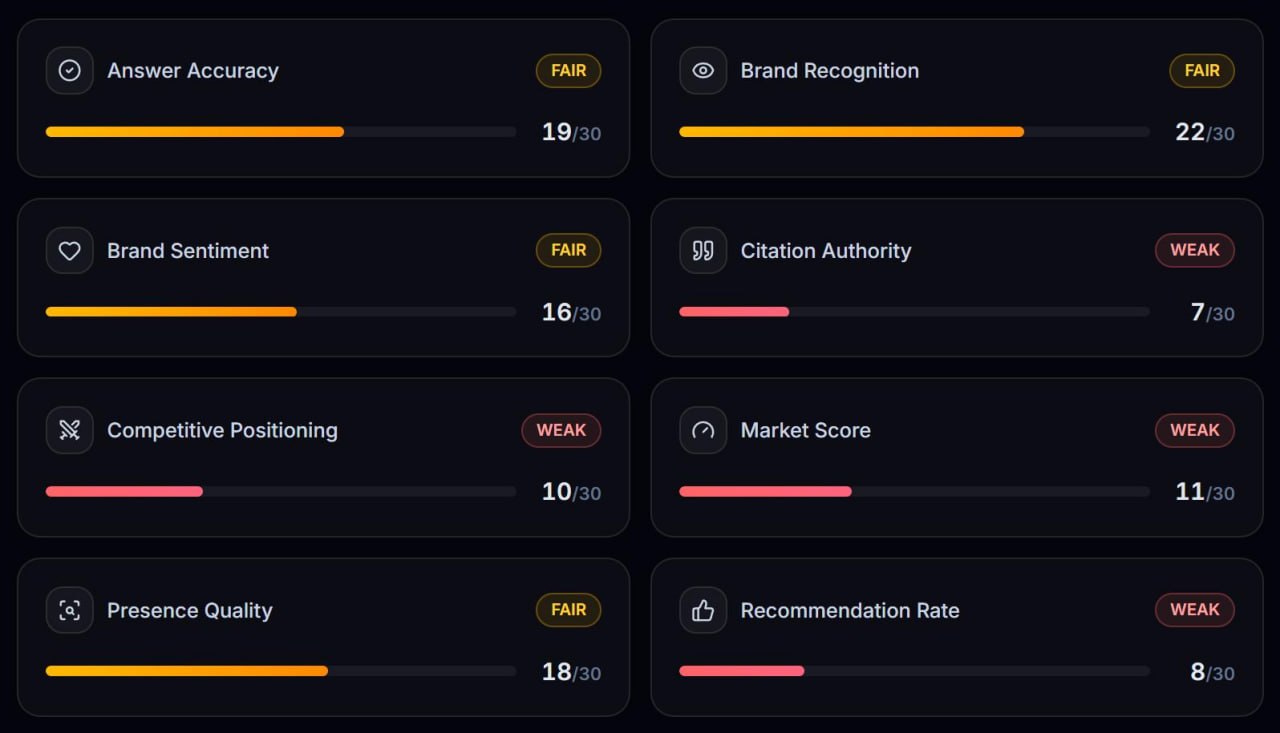
BrandAEO evaluated Workday across 5 AI answer engines (OpenAI, Gemini, Perplexity, DeepSeek, Qwen) and 10 visibility dimensions (each scored 0-30). Workday currently has an Overall Score of 1283, indicating strong presence and recommendation strength when AI models answer saas / software questions.

What is Workday's AEO score?

Workday's Answer Engine Optimization (AEO) Overall Score is 1283 on BrandAEO's open scale — the sum of 10 visibility dimensions each scored 0-30 — an independent assessment of how visible, accurately described, and frequently recommended Workday is inside AI-generated answers.

How can Workday improve its visibility in AI answers?

Workday can improve its AEO score by strengthening authoritative citations, publishing clear structured content about its products, earning third-party mentions, and ensuring consistent, accurate brand information across the web that AI engines can retrieve and cite.